Packing Supplies: What You Actually Need (and What You Don't)
Most people buy the wrong mix of packing supplies: too many large boxes, not enough small ones, and nowhere near enough tape.
Here is what actually earns its place.
Boxes, and why small ones matter most
The instinct is to buy big boxes so there are fewer of them. It is the wrong instinct. A large box filled with books is too heavy to lift safely and will fail at the seams.
The rule is straightforward: heavy things in small boxes, light things in large boxes.
- Small (about 1.5 cu ft) — books, tinned food, tools, records. You will use more of these than you expect.
- Medium (about 3 cu ft) — the workhorse. Kitchen items, toys, small appliances.
- Large (about 4.5 cu ft) — bedding, cushions, lampshades, winter coats. Bulk, not weight.
- Wardrobe boxes — hanging clothes go straight in on the rail. They feel like a luxury until you have used one.
- Dish barrels / dish packs — thicker walled, for crockery and glass. Worth it.
For a typical three-bedroom house, expect to want considerably more small and medium boxes than large.
Tape
Buy more than you think, and buy decent tape. Cheap tape splits, peels in humidity and does not hold a base.
Get a proper tape gun. It is faster, and it applies even pressure so seams hold. Tape the base of every box along the seam and then across it.
Padding
- Packing paper (plain newsprint) is the default for wrapping. Newspaper transfers ink onto crockery.
- Bubble wrap for anything fragile or with an edge.
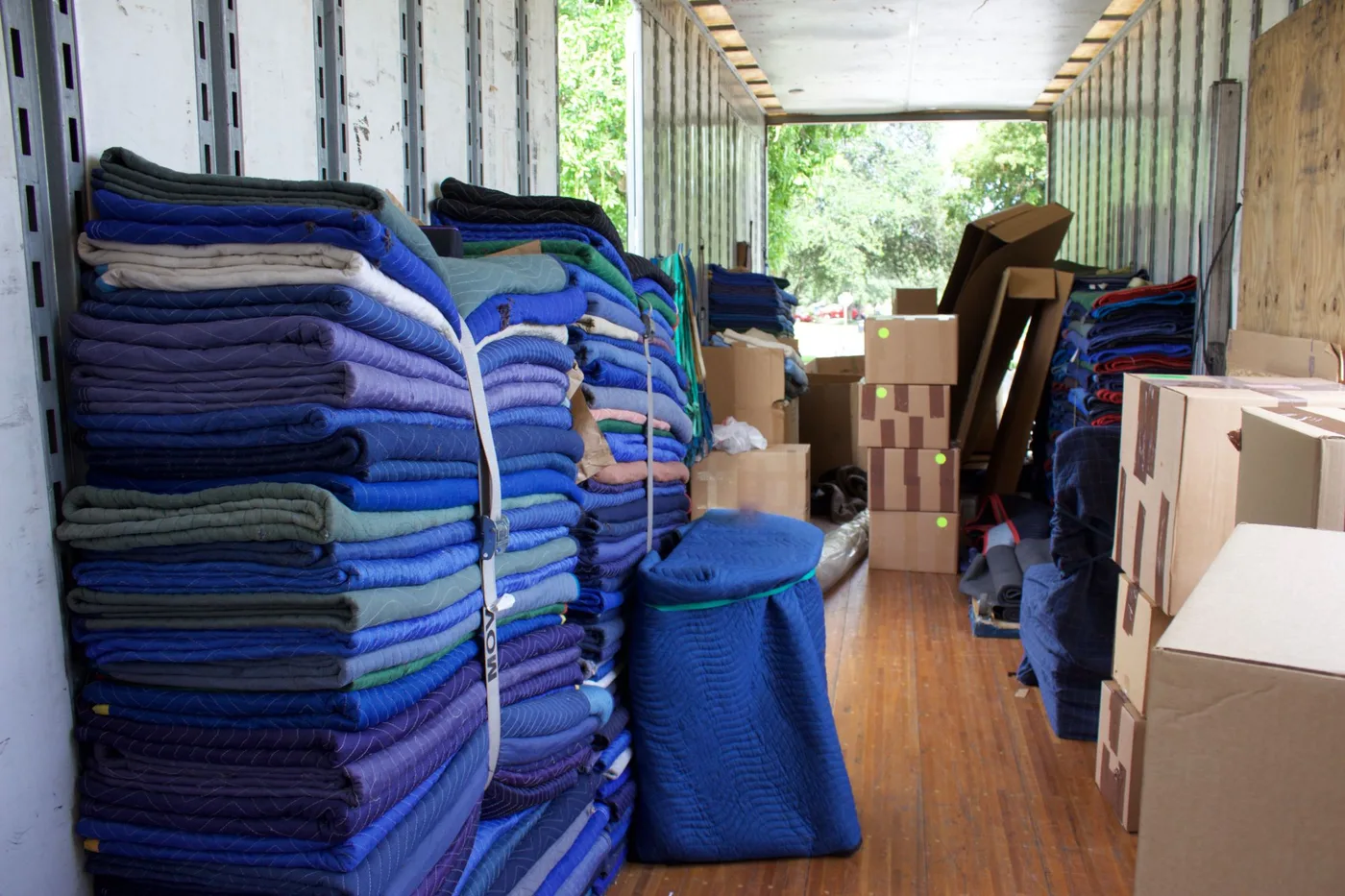
- Furniture blankets for tabletops, headboards and appliances. Movers normally bring these.
- Stretch wrap for keeping drawers shut and blankets in place.
Towels and bedding work as padding, and you are moving them anyway. Just do not rely on them for anything genuinely fragile — see packing fragile items.
Labels and a marker
Label the side, not the top. Once boxes are stacked you cannot see tops.
Write the room and one line about contents. "Kitchen — pans, chopping boards" beats "Kitchen 7" when you are looking for a specific thing at 9pm.
Florida-specific: heat and humidity
Two local considerations that matter more than they would further north:
Cardboard weakens in humidity. A garage in August is not a good place to store packed boxes for three weeks. Pack closer to the date, or keep boxes somewhere air-conditioned.
Heat damages more than you would guess. Candles, vinyl records, some electronics and cosmetics do not enjoy a hot truck or a hot car. Those go with you, in the air conditioning.
What you can skip
- Specialist boxes for everything. Dish packs and wardrobe boxes earn their keep. Most other specialist boxes do not.
- Supermarket boxes. Free, but inconsistent in size, often weakened, and occasionally carrying pests. They do not stack, which slows loading — and on a time-priced local move, slower loading costs money. See what a local move costs.
- Buying in bulk before you have sorted. Declutter first. You will need fewer boxes than you think.
Or skip the whole thing
Packing is the slowest part of a move and the part most people underestimate. If you would rather not do it, our packing and unpacking service covers materials and the work — and it is worth asking about early, because it needs booking alongside the move.
We serve Winter Park, Orlando, Goldenrod, Union Park and the surrounding area.
Call In A Zip Moving on (407) 987-2624 for a free quote.